I have been doing some research lately on education. I have come across this series of TED talks by Sir Ken Robinson which are fascinating (if you’re into this stuff)! He is a British educator living in L.A., who has been called a creativity expert. He’s written some books and has a blog, but I haven’t read those (yet). I’ve only listened to him talk. He is gifted speaker who has profound insight into the problems of our educational system here in the US and other countries in the Western world. He is also very funny!
Here are a few of my takeaways and favorite quotes from the talks that have made me think deeply about the important role of the teacher and how difficult that job can be. Sir Ken says that:
“Teaching is a creative profession.”
Teachers are mentors, they are there to stimulate, provoke, engage, and facilitate learning. But because of the amount of standardized tests that have been mandated by our government, teachers — rather than excite curiosity — are having to be compliant. He goes on to say:
“One role of education is to awaken and develop creativity. Instead, we have a culture of standardization.”
I feel that I have just began to wrap my head around the testing issue. I have three kids in the public school system. One is in high school, one is in middle school, and one is in elementary school. I worry about my middle schooler the most because she is the one who least fits the mold of “student”. Her natural talents have become lost because she is working so hard at just keeping up. School is hard for her and we are trying to figure out why it’s so difficult. But when we do figure it out, I feel that it’s not just our responsibility at home to develop her passions and talents, it has to be a joint effort with her school. We need to work together to develop her creativity (which she has in spades) and focus on her strengths.
Sir Ken says:
“We are educating children out of their creative capacities.”
I dream of a school system where theatre and singing (my daughter’s passions) are equally as important as math. Sir Ken goes on to say:
“Many highly talented, brilliant, creative people think they’re not. Because the thing they were good at at school wasn’t valued or was actually stigmatized.”
My thoughts exactly!
Then Sir Ken Robinson said this in one of his talks:
“Curiosity is the engine of achievement.”
To evoke curiosity in children is the gift of a good teacher. However, it has become very hard for teachers to find enough time in their day to dig deep into the subject matter in an exciting way. They are stuck “teaching to the test”. With my daughter (that creative middle schooler), I feel that the rush of the school day and the cramming in of work has left her feeling disconnected with her teachers. Not only that, sitting down all day with the lack of body movement has been a huge detriment. She is a kinesthetic learner who needs to move to learn. She now calls school “prison”. She’s lost her curiosity, and this breaks my heart.
Am I to tell her that this is it? I wish I didn’t have to, but we don’t have the means to send her to private school so we really do have to make things work within the public school system. Her struggles will be part of her story, I suppose. They will shape her into whoever she might become. For better or for worse.
What I really want, though, is for things to be different. For her school experience to be something that I’ve only read about. Like in Finland, for example. They created a brand new school system from scratch 40 years ago. They began to base their education on equality so that they could make sure to develop everyone’s potential. They realized that children need more than just academics. In Finland, their school days are shorter, their outdoor play is longer (75 minutes per day), they teach life skills classes throughout the day (like cooking, sewing, health and sports) and have a heavy focus on the arts. There is just one standardized test at the age of 16, and they have a 93% high school graduation rate.
It gets even more interesting. In Finland, 43% of kids who graduate high school go to vocational school, and there is no stigma attached to this path. Finland says that they are investing in their children. Their economy needs all types of people and that everyone has worth.
But the real reason for Finland’s success is found in their teachers. Teachers in Finland are viewed with the same regard as doctors and lawyers. In fact, 25% of students choose to go into the teaching profession, but only about 10% get accepted into the Master’s program. Teachers also get a high level of support in the classroom, and they are allowed to create their own curriculums and even their own grading systems. It is this autonomy and freedom that not only allows for creativity, but helps them build strong relationships with their students because they are focused on developing their strengths.
I know people here are sometimes weary of the Finland vs. US comparison, especially because Finland is a small country with socialistic characteristics (all education including college is free). But I do think there are some lessons that can be taken away from their remarkable progress. As Sir Ken put it so eloquently, as he compared the success of a school system to that of agriculture:
“With organic systems, if the conditions are right, life is inevitable. It happens all the time. You take an area, a school, a district, and you change the conditions and give people a different sense of possibility, a different set of expectations, a broader range of opportunity, you cherish and value the relationship between teachers and learners, you offer people discretion to be creative and innovate in what they do – schools that were once bereft spring to life.”
He believes that change is possible, but there needs to be a movement. If enough people move, it can be a revolution!
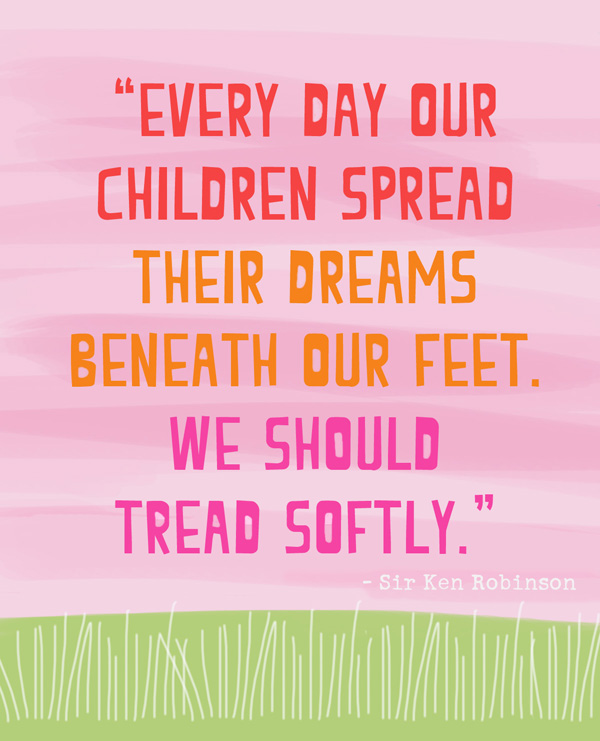
Which brings me to the quote above, the one about treading softly. I love this one because it reminds me that there is a world in which our children live that we know very little about. It’s a world in which they dream about their future. We might know their dreams, but we might not. Maybe they don’t even know them yet. Maybe they are just building memories and finding their passion. What we do know is that it is a creative world, because humans are inherently creative. I mean, we all create our own lives, don’t we? And every life is different and unique. No two are the same.
Our educational system, however, is based on sameness. It follows a linear path rather than an organic one. Sir Ken says:
“The reason so many people are opting out of education is because it doesn’t feed their spirit, their energy or their passion.”
Feeding the spirit is such a wonderful phrase. It reminds me of why I care so much about “the arts” and “creativity” in school. Sir Ken goes on to say this other poignant sentence:
“The arts aren’t just important because they improve math scores, they are important because they speak to parts of children’s being which are otherwise untouched.”
How very true.
Sir Ken is known best for this quote (it has been traveling about Pinterest and Facebook lately):
“Creativity is as important in eduction as literacy.”
Do you agree?
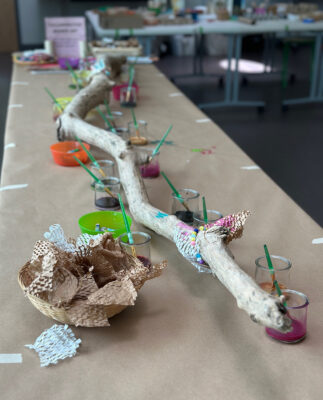
There is a reason I continue to put out art supplies and invitations to create in my home, and it’s to remind my kids that in this house we value creativity as much as academics. Maybe even more than. It’s the best I can do to feed their spirits, and to help them understand that their lives are not typical. Their lives are original.
Here are Sir Ken Robinson’s TED talks, in order:
Do Schools Kill Creativity? (2007)
Bring on the learning Revolution (2010)
How to Escape Education’s Death Valley (2013)
Thanks for reading this, and please comment if you have anything to add or share.
xo, Bar


Thanks so much for bringing up this important topic Bar! My kids attend private school and although they don’t “teach to the test” I do have my concerns. This year they decided to give standardized testing to first graders (my son’s class) for the first time. I wrote to the principal letting her know I was NOT happy. The kids are far too young and they could spend the week in much more productive ways. Three kids cried one day because the test was so hard – ridiculous! I will say that their school, although they are hopping on the STEM bandwagon, still focuses on the arts, although not nearly as much as I would like. 🙂 Therefore, like you, I supplement their art education at home. I do believe the primary educator of a child is the parent so I’m sure you will work it out with your middle school girl. She is luck to have you as a mom. 🙂
In terms of creativity and education in America, it does seem that education has been dumbed down now for decades. But one doesn’t need to look far to see creativity everywhere. Just look at Apple. That’s an American company. Americans have great ideas and are making amazing contributions to the world. I’m sure good things are coming out of Finland, but none come to mind at the moment. Still, we could learn a lot from their schooling system, I’m sure. Thanks again for this post!
hi Kristen!! thank you for leaving a comment…i love reading a little bit about your life. I think that in elementary school, i don’t really have as many issues with school. yes, there is testing which — like you — makes me cringe. but overall i find that the teachers are pretty great about making the day fun and they work hard at connecting with the kids. my kids all loved elementary (and my youngest is in 3rd grade so still there). it’s when they hit middle school that everything changes! middle school here in my town is 5th-8th. it becomes less fun, more academic and I am noticing how worn out the teachers are. it’s just a really hard job! they do have chorus and art twice a week, but the art is….well, that’s a whole other blog post. and i know how hard being a middle school art teacher can be. it’s just that their day is…uninspired. so yes, thankfully i can supplement at home. the funny thing is that art isn’t even really their passion, but it allows them to be involved with something where there is no right or wrong…just free expression.
and as for Finnish creativity….hmmm, Merimekko maybe, i think she’s Finnish? I think our country does innovate, that’s for sure. it would be interesting to research the correlation between innovators and dropping out of school. i have no data to support this, but i feel like the innovators that i know about all left school to follow their creative passions.
actually, ken robinson wrote a book (which i just bought) called The Element where he writes about how finding your passion changes everything, and he does some case studies on famous people. can’t wait to read it. it’s all just so interesting to me.
thank you for sharing all of this, kristen!! xo bar
I’m not sure I have anything to add, but I wanted to thank you for your thoughts on the topic! I am not a teacher, but I recently started working in my children’s public elementary school. Our teachers are soooo dedicated and work so hard, but I see the standardized testing issues cropping up, especially with less experienced teachers. It is incredibly hard to figure out how to best measure how our kids are doing and also how our teachers are performing.
thanks Amy for adding to this conversation. i agree that is really challenging to find a way to measure the teachers and kids without it becoming just a sea of paperwork and frustration, not to mention a dwindling of creativity in the classroom. luckily i’m not the one who has to figure this out! i’m just a bystander trying to take it all in and assess the state of my own children. and having the point of view of someone who has a child in all 3 formal schooling ages (elementary, middle, high) i can see where it’s all leading. thanks for adding your comment!!
Reading other comments reminded me how different my own K-12 education was compared to what my sons have. I don’t remember having art class in elementary school at all, and my kids’ school is blessed with a full time art teacher who does amazing things with them.
My required art class the first year of middle school included sculpture, watercolor, enamels and pottery, which is pretty dang cool looking back. My 7th grader requested two art classes for electives this year and got zero, mostly because the art teacher is only in their school for one trimester!
I took more art classes throughout high school and had the chance to try so many things. I ended up going to engineering school, and I was completely surprised that a university had fewer art resources than my public high school! I think it will be tougher and tougher for my older one to fit any type of creative class into his schedule going forward because of all the classes they “have” to take to get ready for college. I still enjoy creating just for myself, and get to expose my kids as well.
Just began following your blog and I have been bookmarking everything! You look like you have so much fun with your work and I love following along.
I also am a big fan of Sir Ken Burns and I take to heart what he says about how we educate children out of their creative capacities. I had to work hard to believe that I am an artist and a creative thinker. I was depressed as a child, starting around those middle school years, and I wasn’t exactly struggling but just bored and misunderstood. I feel that I mentally shut off at school and did not retain much else until I took classes that interested me. Fortunately I took photography, animation and graphic arts in High School (now only photography is an available elective).
I went to college and learned about Child Development and felt that every student should have to take classes in Human Development in HS at the very least. But then after many Child Development classes I figured out that early childhood education programs cater to the whole child and multiple intelligences and then in public school it pretty much it all gets thrown out the window. When before the kids were free to learn how they do it best it changed to sit down in this desk for eight hours. It just boggled my mind and I have been researching education styles ever since.
Now I have a three year old and really want to home school her and I think it will be awesome for my family. I honestly believe that my child already goes forth with a gusto to what she wants to learn. I believe that it will be a fascinating journey but I know that its not an option for everyone. Thank you for sharing this post!
susan, i agree. the early childhood programs are so wonderful. and elementary school is pretty great too, although they start testing them early and asking them to sit still. but it’s when they get to middle and high school that i think so many children are misunderstood, lost, and uninspired. i’m sorry you had to go through what you did in middle school. i think many creatives feel a version of that during those years. but you eventually found what excited you which is so great. i believe that the things we go through as children and adolescents make us who we are. and in your case, it has made you a better parent! bravo for choosing the homeschool road. i hope it goes well for you. i think if it feels right, then it will!! thanks for leaving a comment!! xo bar
I agree very much with this post, and also am an admirer of Ken Robinson. My daughter loves being creative — her weekly class at a local art studio is one of her favorite things to do! Luckily, her art teacher at her current school (grades 1-3) has been wonderfully supportive as well. She even goes above and beyond to exhibit her students’ work at the annual art exhibit in our town. This has made my daughter feel so special and honored to have been selected for this (especially as a non-sporty kid who misses out on the soccer trophies, etc.) Thanks for sharing!
hi Jen, i love to hear that you are indulging your daughter in her passions. and that she is being rewarded for that effort. how amazing, what wonderful memories you are helping to create for her! i hope she continues to love to make art. as Ken Robinson says….it speaks to her soul. thank you for leaving a comment!
I love this article and was familiar with his work. Since having kids and raising them abroad I’ve become uber-interested in education + so many different perspectives + “why do I believe what I believe” — I often joke that this lead me to research pre-schools and self-evaluate as though I was entering the kids in Harvard at pre-school level. I don’t mean that to be that my aspirations were purely “Tiger Mother” but instead “where do I stand in this now that I’m in a new culture:” although I want the kids to be able to reach the stars, I’ve been so fascinated with the tremendous differences I see in educations and cultural relations to it in Sweden, France and the US (our 3 family cultures and 3 school cultures) and how each system reaches “for the stars” with education differently. All have their strengths and weaknesses. I include Finish education in this conversation since we live in Sweden, you can bet that the talk of the Finish educational system hits our news regularly. It hits nerves because Sweden, like many other countries is socially savvy + has had a vital economy over the past 20 years and has also followed a “hands-off” teaching trend for even longer (putting heavy stress on children’s right, no grades, very little “saying no, very few academdic expectation until high school or accountabity along with low salaries/status for teachers or choice of schools; which, if I follow correctly, was true earlier in Finland as well) and if one speaks to educators here in Sweden they see the difference in the levels of the students over this period of time, too. Levels of education have declined; but, over the past 4 years Sweden is moving the direction of Finland, too. Teaching qualifications have changed in the last 2 years and I look forward to seeing where this trend goes. SO much more I could add to the conversion and love this article. Keep them up and I look forward to learning more!
Since Finland and Sweden are both Nordic countries I’ve pondered again and again and again: what’s the difference and I see that you’re hitting upon it: it’s the respect + value for teaching; not only as a career choice but this appreciating or value of teachers translates into creating an environment where learning, curiously and growing can thrive and is valued. I’ve talked to Finns and read articles the fact that in school classrooms are quiet, kids listen + love to learn time and time again.
There are so many things that I could add to this well written review but, first just want to say that I’m so happy that you’re putting it out there for conversation. I think that open minds, education, respect (for others and educations) and curiosity are the keys to to world and think over and over again: my gosh, our job is to literally “grow the next generation” and I’m fortunate enough to have the time and possibility to think about it.
thank you for your thoughts, Gina, they are SO interesting!! your perspective of living next to Finland is a really interesting one. can we just go out for a tea??? it’s not fair that you live so far away when we clearly have so much to discuss!! and yes, i think one key difference which has helped change the Finnish educational system is the high standards and respect of teachers. i would be so interested to visit some Finnish schools, have you ever been to any? thank you for leaving a comment Gina! xoxo bar